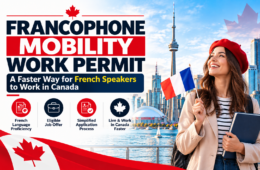
Francophone Mobility Work Permit: A Faster Way for French Speakers to Work in Canada
Canada’s immigration system rewards skills that help communities grow, and French is one of them. If you speak French and have a job offer from an employer outside Quebec, the Francophone Mobility work permit may let you start working in Canada without the lengthy Labour Market Impact Assessment (LMIA) process.
At AeroPath Immigration, we regularly guide skilled workers and employers through LMIA-exempt routes. This guide explains how the Francophone Mobility Program works, who qualifies, what to prepare, and the mistakes to avoid.
What Is the Francophone Mobility Program?
The Francophone Mobility Program is part of Canada’s International Mobility Program. It supports Francophone communities across the country by making it easier for French-speaking workers to fill jobs in provinces and territories outside Quebec, including Ontario, Alberta, British Columbia, Manitoba, New Brunswick and others.
Normally, an employer who wants to hire a foreign worker must first obtain a positive LMIA, which proves that no Canadian worker was available for the role. Under this program, the employer is exempt from the LMIA and applies under exemption code C16. That saves time, cost and paperwork for both sides.
Who Is Eligible?
To qualify for a Francophone Mobility work permit, you generally need to meet the following conditions:
- A job offer from an employer in Canada for a position located outside Quebec.
- French as your everyday language. You must show intermediate French speaking and listening ability, equivalent to NCLC level 5 or higher. Reading and writing are not assessed.
- A skilled occupation. The job must fall within the eligible skill levels of Canada’s National Occupational Classification (NOC). Eligible TEER categories can be updated by IRCC, so we confirm this for your role before you apply.
- General admissibility. You must satisfy normal requirements, such as a valid passport, no criminal or medical inadmissibility, and proof that you will leave Canada if your permit expires without renewal.
There is no minimum age, and you do not need to be from a French-speaking country. What matters is your French ability and your job offer.
Why Choose This Pathway?
1. No LMIA required. Skipping the LMIA removes months of employer preparation, recruitment advertising and government fees.
2. Faster hiring. Employers can fill urgent vacancies sooner, which makes your application more attractive to them.
3. Canadian work experience. Skilled work experience in Canada can add valuable points under Express Entry, including the French-language and Canadian-experience factors, and may help you qualify for permanent residence.
4. Family options. Spouses or common-law partners and dependent children may be able to accompany you. Depending on your job’s skill level, your spouse may qualify for an open work permit.
5. Strong demand. Many Francophone and bilingual communities struggle to find enough French-speaking staff in healthcare, education, customer service, trades, logistics and technology.
How the Application Process Works
The process has two parts: one for the employer and one for you.
Step 1: The employer submits the offer of employment. Before you can apply, your employer must register on IRCC’s Employer Portal, submit the job offer details under exemption C16 and pay the employer compliance fee, currently CAD $230. IRCC then issues an offer of employment number.
Step 2: You apply for the work permit. Using that number, you create an online IRCC account, complete the forms and upload your documents, then pay your fees and biometrics.
Step 3: Provide proof of French. Accepted evidence may include approved test results such as TEF Canada or TCF Canada, or other documents showing French is your first or main language of education or work. A qualifying test result is the cleanest option.
Step 4: IRCC reviews your file. Officers assess your eligibility, the genuineness of the job and the employer’s compliance history. The job offer is checked at the time of your application, so accuracy matters.
Step 5: Decision and travel. If approved, you receive a letter of introduction (or your permit if already in Canada) and can travel to start work.
Documents Checklist
- Valid passport
- Offer of employment number and a signed job offer letter
- French-language test results or other proof of ability
- Résumé, education credentials and proof of experience matching the NOC requirements
- Police certificates and medical exam, if required
- Photos, biometrics and proof of fees paid
- Relationship documents if your family is applying with you
Fees change periodically, so always check the current IRCC fee schedule before submitting.
Permit Validity and Renewal
The Francophone Mobility permit is usually employer-specific, meaning you can work only for the employer named on it. It is generally valid for the length of the job offer or until your passport expires, whichever comes first. If you continue working for the same employer and still meet the conditions, you may be able to extend it. Changing employers typically requires a new offer and a new permit.
Common Mistakes to Avoid
- Weak French evidence. Submitting unclear or outdated proof is one of the most frequent causes of refusal. Book an approved test early.
- Wrong NOC code. Choosing a code that does not match your real duties can lead to rejection or misrepresentation concerns.
- Job location in Quebec. This program does not apply to Quebec positions, which follow a separate system.
- Incomplete employer submissions. Missing details or unpaid compliance fees delay the offer number.
- Inconsistent information. Your résumé, job offer and forms must tell the same story.
From Work Permit to Permanent Residence
Many workers use this permit as a stepping stone. Canadian skilled work experience, strong French and English scores, and an employer who values you can make you a strong candidate for Express Entry or provincial nomination programs, including Francophone-focused streams in several provinces. Planning this path from the start can improve your long-term outcome.
How AeroPath Immigration Can Help
A strong Francophone Mobility application depends on matching the right occupation, the right evidence and the right employer filing. At AeroPath Immigration, we can:
- Assess whether your French level and job offer qualify
- Guide employers through C16 submissions and the compliance fee
- Prepare and review your complete work permit application
- Plan your next step toward permanent residence
Whether you are a skilled worker searching for opportunities or a Canadian employer who needs bilingual talent, our team is ready to help.
Ready to Start?
If you speak French and want to build a career in Canada, the Francophone Mobility work permit could be your fastest route. Contact AeroPath Immigration today at aeropathimmigration.com to book a consultation and get a clear, personalized plan.
Frequently Asked Questions
1. Do I need an LMIA for the Francophone Mobility work permit?
No. Employers apply under exemption code C16, so no LMIA is needed.
2. Can I apply for a job in Quebec?
No. The program is for jobs outside Quebec.
3. Do I need to be tested in reading and writing French?
No. Only intermediate speaking and listening are assessed.
4. Can my family come with me?
Often yes. Spouses and dependent children may apply, and your spouse may be eligible for an open work permit depending on your job.
5. Will this help me get permanent residence?
It can. Canadian work experience and French ability both strengthen Express Entry and provincial nominee profiles.
Disclaimer: This article is general information, not legal advice. Immigration rules and fees change. Please consult a licensed professional or check IRCC before applying