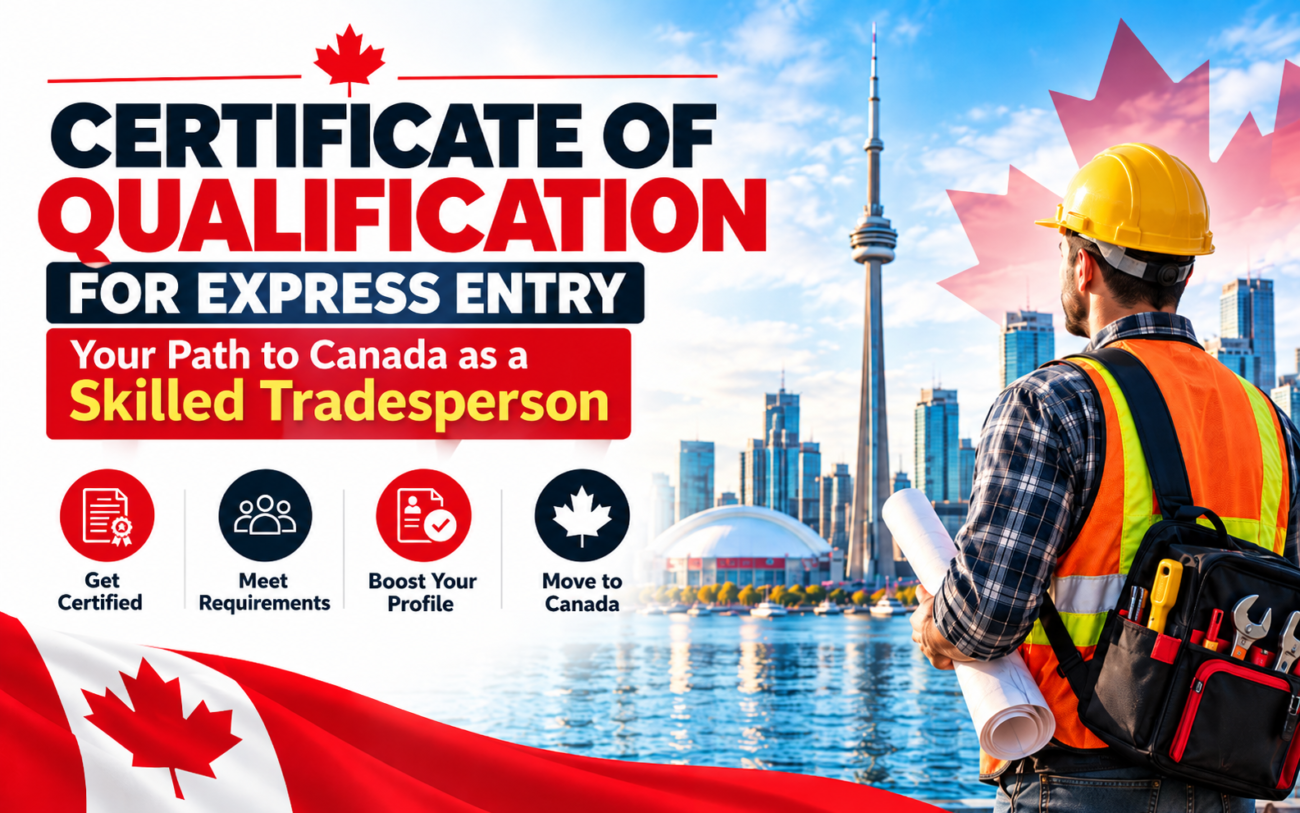
Certificate of Qualification for Express Entry: Your Path to Canada as a Skilled Tradesperson
Canada is facing a real shortage of qualified electricians, welders, plumbers, carpenters, mechanics and other skilled workers. For tradespeople abroad, that shortage is an opportunity. One of the most direct routes to permanent residence is the Federal Skilled Trades Program (FSTP), managed through Express Entry. And for many trades, the key that opens that door is a document called the Certificate of Qualification.
In this guide, AeroPath Immigration explains what the certificate is, who needs it, how the process works, and how to avoid the mistakes that slow applicants down.
What Is a Certificate of Qualification?
A Certificate of Qualification (often shortened to CoQ or C of Q) is an official credential issued by a provincial or territorial trade authority in Canada. It confirms that you have the skills, knowledge and experience to work in a particular trade at the Canadian standard.
In Canada, trades are regulated at the provincial level. Some are “compulsory,” meaning you cannot legally work in them without being certified. Others are “voluntary,” where certification is optional but valued by employers. The certificate is usually earned by passing a trade exam, and in many cases that exam carries the Red Seal endorsement, which allows you to work across most of the country.
Why It Matters for Express Entry
Express Entry is Canada’s main system for managing skilled-worker applications. The Federal Skilled Trades Program is one of its streams, built specifically for people qualified in a skilled trade.
To be eligible under the FSTP, you generally need to show one of two things:
- A valid job offer of at least one year from up to two Canadian employers, or
- A Certificate of Qualification issued by a Canadian provincial, territorial or federal authority.
This makes the certificate especially valuable if you do not yet have an employer in Canada. It acts as proof that your skills meet Canadian standards, and it can support your profile when invitations to apply are issued.
Core FSTP Requirements at a Glance
Besides the job offer or certificate, applicants are typically assessed on the following:
- Work experience: At least two years of full-time (or equal part-time) experience in your skilled trade within the five years before applying.
- Qualifying occupation: Your trade must fall under an eligible category of the National Occupational Classification (NOC), such as industrial and electrical trades, construction trades, maintenance and equipment operation trades, or certain chefs and butchers.
- Language ability: Minimum Canadian Language Benchmark (CLB) scores in English or French, generally higher for speaking and listening than for reading and writing.
- Job requirements: You must have met the employment requirements of your trade, apart from Canadian licensing.
- Intention to live outside Quebec: Quebec runs its own selection system.
Because eligibility rules and minimums are updated from time to time, always confirm the latest criteria on the official IRCC website or with a regulated consultant before you apply.
How to Get Your Certificate of Qualification
The process varies by province and trade, but most applicants follow a similar path.
1. Identify your trade and your province. Find the authority that regulates your trade in the province where you plan to settle. Each one has its own application process and fees.
2. Submit an application with proof of experience. You will usually provide work history letters, employer references, pay records and sometimes training certificates. Strong, detailed documentation is the single biggest factor in a smooth assessment.
3. Have your credentials assessed. The authority reviews whether your hours and training meet its standard. They may ask for more information or recognise only part of your experience.
4. Pass the certification exam. Many applicants must write a trade exam. Preparing with official study guides and practice questions greatly improves your chances. Some people also need to complete a bridging course or short practical assessment.
5. Receive your certificate. Once all conditions are satisfied, the authority issues the Certificate of Qualification, which you can then use in your Express Entry profile.
Some provinces have started allowing assessment from outside Canada, but options differ widely, so check what is available for your specific trade.
Certificate of Qualification vs. Job Offer: Which Is Better?
Neither is automatically better. It depends on your situation.
- A job offer shows that a Canadian employer wants you, but finding one from overseas can be slow and uncertain.
- A Certificate of Qualification is portable and is in your own hands. It does not depend on a single employer and can open doors across several pathways.
For many tradespeople, the strongest strategy is to pursue both: begin the certification process while building employer connections.
Boosting Your Express Entry Profile
Once you are eligible, your Comprehensive Ranking System (CRS) score decides how competitive you are. These steps can help:
- Improve your language scores. Retaking an approved test such as IELTS or CELPIP, or TEF/TCF for French, can add significant points.
- Learn French. Strong French ability earns extra points and may place you in targeted draws.
- Gain more experience. Additional skilled work, especially Canadian experience, strengthens your profile.
- Consider provincial nomination. A provincial nomination adds a substantial number of points. Many provinces actively look for tradespeople in demand.
- Watch for trade-focused draws. IRCC periodically holds category-based draws for specific occupations, including skilled trades, so keeping your profile active and up to date matters.
Common Mistakes to Avoid
- Weak experience letters. Vague or incomplete references are a leading cause of delays and refusals.
- Applying to the wrong authority. Each trade and province has its own rules; check before paying any fees.
- Ignoring language requirements. A certificate alone will not make you eligible if your language scores are below the minimum.
- Misrepresenting information. Errors or false statements can lead to refusal and a ban on future applications.
- Relying on outdated advice. Immigration rules change often, so rely on current, official sources.
Why Work With AeroPath Immigration?
Navigating two systems at once, provincial trade certification and federal immigration, can feel overwhelming. At AeroPath Immigration, we help skilled tradespeople understand their eligibility, organise strong documentation, choose the right province and build the best possible Express Entry strategy. Whether you are just starting to explore your options or you are ready to submit your profile, we offer clear, honest guidance at every step.
Frequently Asked Questions
1. Do all trades need a Certificate of Qualification for Express Entry?
Not always. The FSTP requires either a valid job offer or a certificate. However, in compulsory trades, you must be certified to work, so the certificate is usually essential.
2. Is a Red Seal the same as a Certificate of Qualification?
No. The Red Seal is an interprovincial endorsement added to a certificate when you pass the Red Seal exam. The Certificate of Qualification is the underlying provincial credential.
3. How long does it take to get the certificate?
Timelines vary by province, trade and the completeness of your documents, so it is wise to start early.
4. Can I apply from outside Canada?
Some authorities allow it, while others require you to be in the province. Check the rules for your trade.
Start Your Journey Today
A Certificate of Qualification can be the turning point in your move to Canada. With the right preparation and expert support, your trade skills can become the foundation of a new life.
Ready to take the next step? Visit AeroPath Immigration to book a consultation and find out how we can help you build your pathway to Canada.
Disclaimer: This article is for general information only and does not constitute legal or immigration advice. Immigration programs and requirements change frequently; confirm current details with IRCC or a licensed immigration professional.