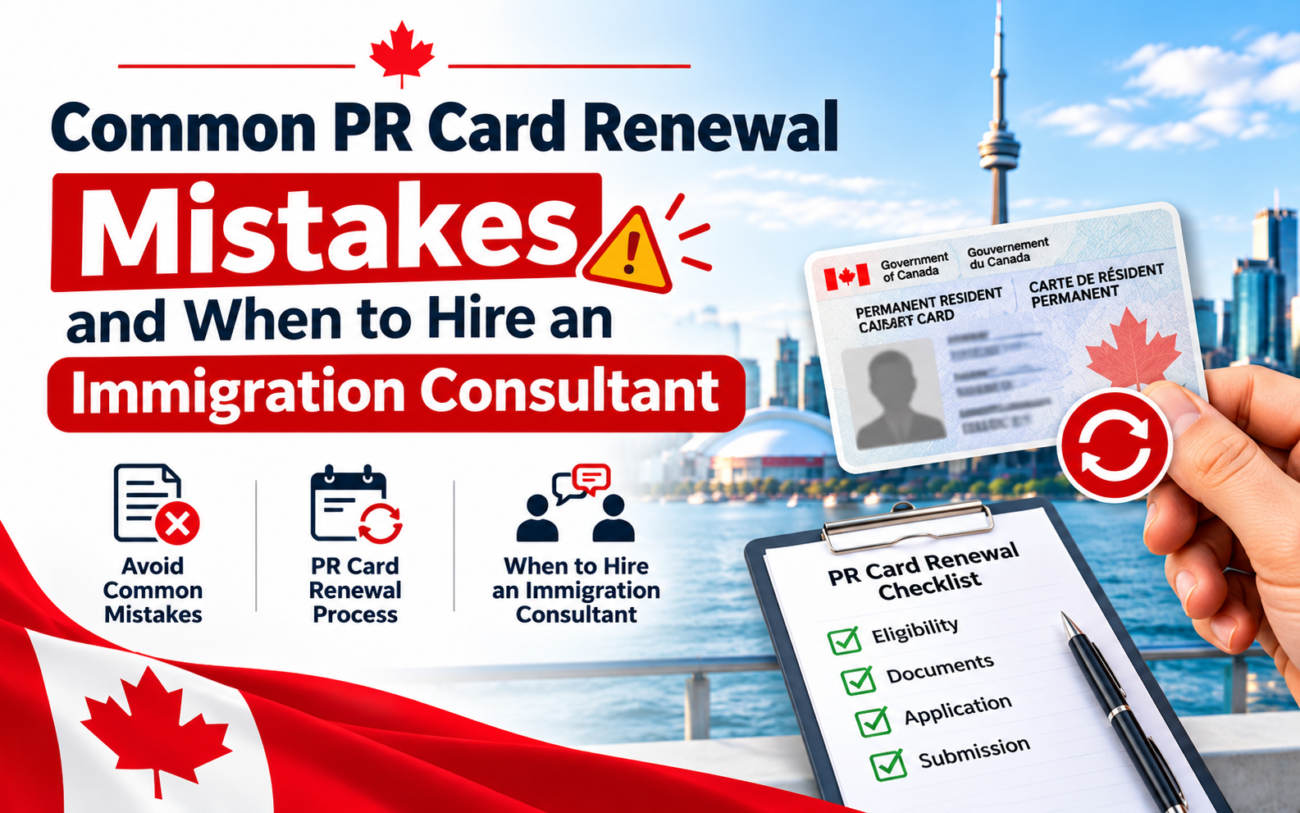
Common PR Card Renewal Mistakes and When to Hire an Immigration Consultant
Renewing a Canadian PR card is a $50, mostly online application, but small errors in the residency proof, photo or paperwork can get it returned or, worse, trigger a review of your status. If you are a permanent resident in Canada, this guide walks you through each step of the renewal, shows the mistakes we see most often, and explains when it makes sense to get professional help.
Your PR card is the official proof of your status, and you need a valid card or a permanent resident travel document to board a plane, train, bus or boat to Canada. IRCC’s own guidance puts the responsibility squarely on you: it is up to you to make sure your card is valid when you return from a trip and to apply before it expires.
Step 1: Check your eligibility and residency obligation
You can renew only if you meet the residency obligation: at least 730 days physically in Canada in the five years before you apply. Those days do not need to be consecutive. Check this before anything else, because it decides whether your renewal is routine or risky.
Per IRCC, you are eligible to apply for a card if you:
- are a permanent resident of Canada
- are physically present in Canada when you apply
- meet the residency requirement
- are not under an effective removal order
- are not a Canadian citizen
- have not been convicted of an offence related to misuse of a PR card
When to apply
Renew if your card will expire in less than nine months, or if it has already expired. If your card is still valid for more than nine months, IRCC says your application will be returned unless your legal name or gender has changed.
How to count your 730 days
Count backward five years from the date you apply and add up every day you were in Canada. IRCC’s officer guidance notes that the day you left and the day you returned both count as days in Canada. If you have been a permanent resident for less than five years, you must show you can still reach 730 days within five years of landing.
Some days abroad can count toward the 730, but only in specific situations, and each needs proof:
- Working abroad: you are assigned full-time outside Canada by a Canadian business or the public service, and you will keep working for that employer in Canada afterwards.
- Accompanying a Canadian citizen: your spouse, common-law partner or (for children) parent.
- Accompanying a permanent resident who is your spouse, common-law partner or parent and who is employed full-time by a Canadian business or the public service.
If you fall short, you may still ask an officer to consider humanitarian and compassionate grounds, but you must show exceptional circumstances beyond your control. This is the moment to speak to a professional before you file (see the section on hiring a consultant below).
Keep a travel journal. IRCC recommends recording your trips outside Canada, and it will make the time-outside-Canada table on the form far easier to complete accurately.
Step 2: Gather your documents (sample document list)
IRCC returns applications with missing documents or unclear copies, so build your file before you open the portal. Use the official Document Checklist (IMM 5644) to confirm exactly what applies to you; the table below is a practical sample for a standard renewal.
| Document | What IRCC expects | Watch out for |
| Application for a PR Card (IMM 5444) | Completed online in the Permanent Residence Portal; every question answered, “N/A” where it does not apply | Blank sections get the application returned |
| Document Checklist (IMM 5644) | Completed and uploaded with the application | Forgetting to upload it |
| Fee receipt | Proof of the $50 payment made on IRCC’s online payment page | Uploading the wrong receipt, or no receipt |
| Digital photo | One photo taken within 12 months, as JPEG or PNG, 715×1000 to 2,000×2,800 pixels, under 4 MB, white background | Dark photos, glare, hidden facial features, a phone picture of a paper print |
| Photo back details | Studio confirmation or receipt uploaded under “Upload your photo (back)” | Skipping the back-of-photo information |
| Primary ID | Copy of your valid passport or travel document showing type, number, issue and expiry dates, name, photo and birth date | Cut-off or blurry scans |
| Current PR card | Copy of your existing card | Sending the original card |
| Proof of residency | Copies of at least 2 pieces of evidence covering the past five years, such as pay stubs, bank statements, CRA Notices of Assessment, benefit records, rental agreements or club memberships | One thin document, or evidence that covers only part of the five years |
| Time outside Canada | Every absence in the past five years entered in the table on IMM 5444 | Missing or inaccurate trips |
| Translations | English or French translation of any other-language document, plus an affidavit unless the translator is a Canadian certified translator | Translations done by you or a family member |
| Certified copies (if required) | Certified by a notary public or commissioner of oaths, with the required wording | Certification by a relative |
| Use of a Representative (IMM 5476) | Only if a consultant or lawyer helps you; you and the representative both sign by hand | Missing signatures |
Do not send original documents. IRCC says they will not be returned. If you legally changed your name, you must also include the supporting name-change documents and a copy of your Record of Landing or Confirmation of Permanent Residence.
Step 3: Complete and submit the online application
Most people apply through IRCC’s Permanent Residence Portal. Paper applications are limited to people who cannot apply online and need accommodations. The process has five stages:
- Start your application. Sign in to the Permanent Residence Portal and begin the Application for a Permanent Resident Card (IMM 5444). Answer every question; if one does not apply, write “N/A”.
- Upload the additional forms and documents. Complete and upload the Document Checklist (IMM 5644), your photo, passport copy, PR card copy, residency evidence and any translations or name-change papers.
- Pay the fee outside the portal. The portal does not take payment. Pay IRCC’s online fee page by credit card, Debit Mastercard or Visa Debit, then upload the receipt in the Fee Payment section.
- Review, sign and submit. Check that every question is answered and every document is legible. You sign electronically by typing your full name exactly as it appears on your passport. Check your photo carefully: IRCC says that once you press “submit documents” in the photo upload, it can no longer be changed.
- Track your application. Link your application to an IRCC secure account for status updates and messages. Tell IRCC straight away if your address or phone number changes while you wait.
Two details trip people up. First, your card is mailed to an address in Canada, so make sure your address is correct. Second, most renewal applicants do not need to give biometrics; the main exception is someone who was under 14 when their permanent residence application was received (under IRCC’s 2018 biometrics rollout) and is now over 14. If this applies, IRCC will send a biometric instructions letter after you apply.
If you hire a representative, they can complete forms and communicate with IRCC through their own account, but you must be the one to type your name and click submit. IRCC states that this is the legal requirement for your application to be considered signed.
PR card renewal fees and processing times
The government fee is $50 per person, and it is not refunded once IRCC starts processing or if the application is refused. Processing times move, so check IRCC’s official tool on the day you apply rather than relying on any article, including this one. Recent third-party reports in 2026 range from under a month to several months, which is exactly why IRCC’s own tool is the number to trust.
| Item | What to know |
| Fee | $50 per person for a PR card renewal |
| How to pay | Online on IRCC’s payment page; upload the receipt to the portal. Other payment types are returned |
| Refunds | None once processing starts, or if refused |
| Biometrics | Not needed for most renewal applicants; a separate fee applies if IRCC requires them |
| Standard processing | See IRCC’s current processing times |
| Urgent processing | Available only for qualifying travel within three months; the minimum is 3 weeks and nothing is guaranteed |
| Earliest you can renew | When the card expires in less than 9 months |
| Old card validity | Stops being valid 60 days after IRCC issues the new card |
Our timing advice
Apply as soon as you are inside the nine-month window, especially if you plan to travel. Do not book flights on the assumption that the card will arrive in time. IRCC warns that if you leave Canada after a new card has been issued but before you have it in hand, you cannot re-enter by commercial transport with the old card, and you would have to apply for a travel document from abroad.
Urgent processing: who qualifies
You must need the card to travel within the next three months, and the reason must be one of these: your own serious illness, the serious illness or death of a family member, work related to your current job or a job opportunity, or a crisis, emergency or vulnerable situation. You must include proof of travel (itinerary or ticket), proof of payment for the trip, a letter explaining the urgency and proof of the urgency, such as a doctor’s note or employer letter. In the portal, tick “Yes, my request is urgent”.
Travelling with an expired card, and the Permanent Resident Travel Document (PRTD)
If your card has expired or is about to, the safest rule is simple: do not fly out of Canada until you hold the new card. You cannot apply for a PR card from outside Canada, and IRCC does not issue or deliver cards overseas to help you return. Without a valid card or a PRTD you may be refused boarding on a flight, train, bus or boat to Canada.
What a PRTD is
A PRTD is a temporary official document that proves your status so transport companies will let you travel to Canada. You are eligible if you are a permanent resident outside Canada, do not hold a valid PR card, meet the residency obligation, and have not lost your status. It is issued for single or multiple entry. If you meet the residency obligation and want multiple entry, you can include a cover letter explaining why.
How to apply
- Apply through the Permanent Residence Portal (paper is possible only where the country supports it, through a visa application centre).
- Use the same IMM 5444 form and the Document Checklist (IMM 5644).
- Include copies of your current passport and the passports used in the past five years, proof of your residency in Canada, and the fee receipt.
- Pay the $50 fee. It is not refunded once processing starts or if you are refused.
- If you are approved, IRCC emails instructions for sending your passport so the PRTD counterfoil can be attached.
A PRTD application is also a residency check. IRCC’s guide states that you must meet the 730-day obligation to qualify, so a long stay abroad can lead to a refusal or a formal status review rather than a quick fix.
Urgent PRTD
If you are already abroad and your flight back is within five days, you can ask for urgent processing. Include proof of travel and payment, a letter explaining the urgency and proof of the urgency. IRCC does not post PRTD processing times, but says it prioritizes these applications, and it cannot guarantee you will get the document on time.
Other ways home
If you are returning to Canada in a private vehicle that you own, borrow or rent, you can use your PR card, a PRTD or other documents accepted by the Canada Border Services Agency. When you are back in Canada, apply for your new PR card right away.
10 common PR card renewal mistakes (and how to avoid them)
Most delays come from avoidable file problems. IRCC says incomplete applications, missing documents and unclear copies are returned, and returned files lose time you may not have. These are the mistakes that matter most.
- Applying too early. If your card is valid for more than nine months, IRCC returns the application unless your name or gender has changed. Wait until you are inside the window.
- Not counting your 730 days first. Many people assume short trips do not matter until the total adds up. Count before you file, using passport stamps, flight records and your travel journal.
- Leaving questions blank. Every question must be answered. Write “N/A” instead of leaving a section empty.
- An inaccurate time-outside-Canada table. IRCC may verify your answers, and giving false or misleading information is a serious offence. List every absence for the full five years.
- Thin proof of residency. IRCC asks for at least two pieces of evidence covering the five-year period. Strong files usually combine employment records, CRA Notices of Assessment, bank statements and a lease or mortgage.
- Photos that do not meet the specification. Dark images, glare, a non-white background, wrong pixel size or a file over 4 MB are common reasons photos are returned. Have a professional photographer prepare the digital file.
- Paying the wrong way. Fees are paid on IRCC’s online payment page, not inside the portal, and the receipt must be uploaded. Any other payment form leads to a returned application.
- Blurry scans and missing pages. Unclear photocopies lead to a returned file. Scan every passport page used in the past five years if your case calls for them, at a readable resolution.
- Using family to translate or certify. Translations and certified copies must not come from you or relatives. Use a certified translator or an authorized person, with an affidavit where needed.
- Booking travel before the card arrives. Your old card stops being valid 60 days after the new one is issued, and a PR card cannot be sent abroad. Delay the trip, or be ready to apply for a PRTD.
Bonus: do not ignore address changes
If you move while your application is in process, tell IRCC straight away. Correspondence and the card itself go to the address on file.
The mistake that costs the most
Filing a renewal when you clearly do not meet 730 days, without a plan. A renewal application is where IRCC assesses your residency, and a shortfall can lead to a formal review of your status rather than a new card. If you suspect you are short, get advice before you submit anything.
When to hire an immigration consultant
You can renew on your own if your file is clean: you are comfortably over 730 days, you have two or more strong residency documents, your passport and card are current, and you are not travelling soon. Professional help pays off when the facts are messy, the stakes are high or time is short.
| Your situation | DIY or get help? |
| Well over 730 days, steady employment and tax records, no urgent travel | DIY is realistic with the checklist below |
| Close to 730 days, or unsure how to count your days | Get an eligibility assessment before you file |
| Under 730 days, or long absences in the past five years | Get advice first; you may need a humanitarian and compassionate case |
| Claiming days abroad for work or for accompanying a spouse or parent | Get help: the proof letters and documents are detailed |
| IRCC has asked you for more documents or a residency questionnaire, or a past application was refused | Get help before replying |
| Card expired or lost while you are abroad, or you need an urgent PRTD | Get help: speed and document quality both matter |
| Name change, documents not in English or French, or applying for a child | Consider a review: translation, certification and guardianship rules are strict |
| You want certainty that nothing is missing before you press submit | A pre-submission file review is a modest cost for peace of mind |
What a consultant can and cannot do
A licensed representative can advise you, prepare your forms and documents, and communicate with IRCC through their own account. They cannot open a portal account for you, sign in with your username and password, or sign the application for you; you type your own name and press submit. Nobody can guarantee approval, so be wary of anyone who does.
How to choose a representative
- Confirm they are authorized to represent clients for a fee: a licensed immigration consultant (RCIC) in good standing or a lawyer.
- Ask for a written scope and total cost before you pay.
- Make sure a Use of a Representative form (IMM 5476) is completed, signed by hand by both of you.
- Avoid anyone who asks for your portal password.
How AeroPath Immigration can help with your PR card renewal
AeroPath Immigration is a Surrey-based immigration consultancy that helps permanent residents renew their PR cards with fewer surprises. Whether you want a second pair of eyes on a file you have already built or someone to handle the whole application, we meet you where you are:
- Application review: we check your forms, photo, residency evidence and time-outside-Canada table against IRCC’s requirements before you submit, and flag gaps while they are still easy to fix.
- Personalized eligibility assessment: we count your days with you, identify any exceptions you can claim, and tell you honestly whether your file is ready or needs a different strategy first.
- Full-service filing support: we prepare the application and supporting documents, set up your representative authorization, and keep you informed through IRCC’s process. You still sign and submit your own application, as IRCC requires.
- Travel and urgent cases: we help with urgent processing requests and with PRTD applications for permanent residents who are stuck abroad.
Book a PR card renewal review with AeroPath Immigration
Downloadable PR card renewal checklist
Tick each item as you go. To publish this as a free download, export the doc as a PDF and link it from your site, or ask me to turn it into a branded one-page PDF.
Before you apply
- My PR card expires in less than 9 months, or has already expired
- I am physically in Canada
- I counted my days in Canada for the past 5 years and have at least 730
- I listed every trip outside Canada, with exact dates
- I am not travelling until my new card arrives
Documents
- Completed Document Checklist (IMM 5644)
- Digital photo taken within 12 months, meeting IRCC specifications (white background, 715×1000 to 2,000×2,800 pixels, under 4 MB)
- Studio confirmation or receipt for the back of the photo
- Clear copy of my valid passport or travel document
- Clear copy of my current PR card
- At least 2 residency documents covering the past 5 years (pay stubs, CRA Notices of Assessment, bank statements, lease, benefit records)
- Translations and affidavits for any non-English or non-French documents
- Name-change documents, if my legal name has changed
- Use of a Representative form (IMM 5476), signed by hand by me and my representative, if I am using one
Application
- Created or signed in to my Permanent Residence Portal account
- Completed IMM 5444 with every question answered
- Paid the $50 fee on IRCC’s online payment page and saved the receipt
- Uploaded the receipt, forms and documents; every scan is readable
- Typed my full name exactly as on my passport, then submitted
- Linked my application to an IRCC secure account
After you submit
- Checked my status and IRCC messages regularly
- Updated IRCC if my address or phone changed
- Destroyed my old card once the new one arrived
PR card renewal FAQ
1. Do I lose my PR status when my card expires?
No. The card is proof of your status, not the status itself. But without a valid card or PRTD you may not be able to board commercial transport to Canada, and you still need to meet the 730-day residency obligation.
2. How early can I renew my PR card?
When your card will expire in less than nine months. If it is valid for longer than that, IRCC returns the application unless your name or gender has changed.
3. How much does it cost to renew a PR card in Canada?
The government fee is $50 per person. It is not refunded once processing starts or if the application is refused.
4. How long does PR card renewal take?
It varies, so check IRCC’s current processing times on the day you apply. Even with urgent processing, IRCC cannot process a PR card in less than three weeks.
5. Can I renew my PR card from outside Canada?
No. You must be physically in Canada to apply for a PR card. If you are abroad without a valid card, apply for a PRTD to return, then renew once you are home.
6. What happens if I do not have 730 days in Canada?
Your application may lead to a residency assessment, and you could lose your status. In some cases, you can count certain days spent abroad, or ask for consideration on humanitarian and compassionate grounds. Speak to a licensed professional before you file.
7. Can I travel while my renewal is being processed?
You can, but it is risky. Your old card stops being valid 60 days after the new one is issued, and the new card cannot be mailed abroad. If you leave and cannot return with a valid card, you would need a PRTD.
8. Can a consultant guarantee my PR card renewal will be approved?
No. No one can guarantee an IRCC decision. A good consultant improves the quality and completeness of your file and tells you honestly where the risks are.
Final thoughts: renew early, file clean, ask for help when the facts are messy
Renewing your PR card is straightforward when you meet the residency obligation, apply inside the nine-month window and submit a complete file. The expensive problems come from guesswork: a miscounted absence, a weak residency file, a photo that gets bounced, or a trip booked before the card arrives.
If your file is clean, use the checklist above and apply on your own. If you are near 730 days, have complicated absences, are stuck abroad, or simply want a professional to check your file before you submit, AeroPath Immigration can review your application, assess your eligibility and handle the filing for you. Contact AeroPath Immigration in Surrey today to book your PR card renewal review.
This article is general information, not legal advice. IRCC fees, forms and processing times change, so confirm current details on IRCC’s website before you apply. Information in this article was checked against IRCC guidance in October 2026.