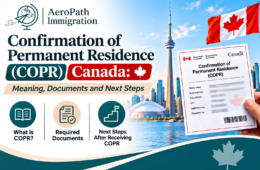
Confirmation of Permanent Residence (COPR) Canada: Meaning, Documents and Next Steps
Receiving a Confirmation of Permanent Residence, usually called a COPR, is the moment many applicants have waited for. It means your application has been approved. It is not yet the end of the process, though. You must still complete the landing, and there are important rules about timing and documents. This guide explains what the COPR is and what to do next.
What Is a COPR?
A COPR is an official document issued by IRCC when a permanent residence application is approved. It confirms that you have been granted permanent resident status, subject to completing the landing process. It shows personal details, a photo, a signature and an expiry date.
Your status as a permanent resident officially begins when you complete the landing, either by arriving in Canada at a port of entry or by confirming your status if you are already in the country. Until that happens, you are not yet a permanent resident.
What Is Included in Your COPR?
- Your full name, date of birth and country of birth.
- Your photo and signature.
- Your unique client identifier.
- The immigration category under which you were approved.
- The date the document was issued and the date it expires.
- Any conditions that apply to your status.
- The same details for any accompanying family members.
Review every detail carefully as soon as you receive it. If you find a mistake, contact IRCC quickly, and do not travel until it is corrected, because a mismatch with your passport can cause problems.
Validity and Timing
The COPR has an expiry date, and it is usually linked to the validity of your medical exam or passport, whichever comes first. You must complete your landing before the document expires. If it expires, you may lose the approval and may need to start over, so plan your move early.
If you live outside Canada, plan your arrival with enough time to settle matters at home, such as housing, work and travel. If you are already in Canada, follow the instructions in your approval message to complete the landing process.
Documents to Bring When You Land
Prepare a complete travel package and keep it in your carry-on bag, not in checked luggage.
- Your COPR, printed, with all pages.
- Your valid passport, and the passports of your family members.
- Any visa or travel authorization required for entry.
- Two copies of a detailed list of the goods you are bringing, and a second list of items arriving later.
- Proof of funds, if you are asked to show it.
- Photos or documents that support your case, such as a job letter or a provincial nomination. Make sure the name and details on your passport match your COPR exactly.
What Happens at the Port of Entry
When you arrive, an officer will check your COPR, your passport and your answers to a few questions. If everything is in order, the officer will confirm your permanent resident status, sign your COPR and give you instructions on the next steps. This process is usually straightforward when documents are complete.
Answer honestly and directly. If the officer asks about a change in your circumstances, such as marital status, a new child or employment, be sure to tell the truth, because inaccurate statements can have serious consequences.
After You Land
1. Keep your signed COPR safe. You may need it for early applications and to prove your status.
2. Wait for your PR card. It is usually mailed to the address you gave, so make sure it is accurate and update it with IRCC if you move.
3. Apply for a Social Insurance Number, which is needed to work and file taxes.
4. Register for provincial health insurance. Waiting periods differ by province, so consider private coverage in the early months.
5. Open a bank account and begin building your credit history.
6. Get a provincial driver’s license and register for local services.
7. Update your address with IRCC if it changes.
Your Responsibilities as a Permanent Resident
To keep your status, you must meet the residency obligation, which generally means living in Canada for at least 730 days in any five-year period. Time spent abroad can count in limited situations, such as accompanying a Canadian spouse, but you should not assume that every trip is safe.
Also remember that permanent residents are not citizens. You can live, work and study anywhere in Canada, and you have most social benefits, but you cannot vote or hold certain jobs, and you may be asked to renew your PR card every five years.
Common Mistakes to Avoid
Missing the expiry date is the most serious error. Another is traveling with a passport that does not match the COPR. Some people forget to bring their goods list, which causes delays, and others fail to update their address, so their PR card is lost in the mail.
Frequently Asked Questions
1. Can I travel before I land if my COPR is valid?
You should not make travel plans that could prevent you from landing before the COPR expires. Plan your arrival date carefully, and keep the document and your passport together.
2. What if my passport expires before I land?
The COPR is connected to the passport details. If the passport expires or changes, contact IRCC for guidance before you travel, because a mismatch can cause delays at the border.
3. When do I get my PR card?
It is usually mailed after landing to the address you provided, so make sure the address is correct. If you move, update your address with IRCC so the card is not lost.
4. Can I leave Canada soon after I land?
You can, but you must meet the residency obligation over time, and a PR card is needed to board many commercial flights back to Canada. Plan any early trips carefully.
Final Thoughts
The COPR is a milestone, but its value depends on completing the next steps on time. Plan your landing, keep your documents safe and settle quickly into your new life.
AeroPath Immigration supports clients from application to landing and beyond. Visit https://aeropathimmigration.com/contact-us to speak with our team about your next steps.